Monitoring proves your AI ran. It can't prove it worked. We can — independently. MarginSignal OS measures whether your AI actually lowered the cost of reaching the right answer, and when it doesn't, names whose fault it was: data, model, operator, or agent. Evidence that holds up, because it doesn't come from the people being graded.
An operator grading its own AI is the conflict. We're the outside check — the same independence principle finance and safety already run on: EU AI Act Article 31 for conformity bodies, SEC/PCAOB auditor rules, the lesson of the 2008 credit ratings. The party with a stake in the answer can't be the one who certifies it.
A dashboard counts the first contact. We follow the whole journey to the real resolution and put an honest dollar cost on it — your true Cost Per Resolution. Did the AI make the right answer cheaper, or just the call faster?
When a chain of agents drops the ball, "the AI failed" isn't an answer. We pinpoint where it broke — data, model, operator, or the exact handoff — in evidence a skeptic can reproduce.
The defensibility isn't a brand or a patent — it's the structure of how the evidence is produced: independent, externally anchored, and reproducible by someone who doesn't trust the operator. (Core methods patent-pending.)
One AI-handled resolution, measured from outside the operator. Illustrative sample.
On a failure like this, fault would land on the model-vendor — correct inputs, wrong determination, dropped at the agent-3 handoff.
Our methodology builds on established service-economics frameworks and published research — the COPC CX Standard, ICMI and HDI practices, and research from Deloitte and McKinsey. We didn't invent these concepts; we built the system that computes them reproducibly and independently.
References to third-party standards and research do not imply endorsement, affiliation, or sponsorship.
Resolution-chain reconstruction is not a default BI model. It requires tracing every contact from first touch to final closure across systems.
CPR economics requires operational domain logic, not just dashboarding. SQL alone doesn't assign dollar impact to behavioral fault lines.
Fault-line mapping takes 15 years of operational pattern recognition, not a sprint with your analytics team.
Time-to-value is weeks, not quarters. Internal build cycles take 3-6 months to scope, build, validate, and get executive buy-in.
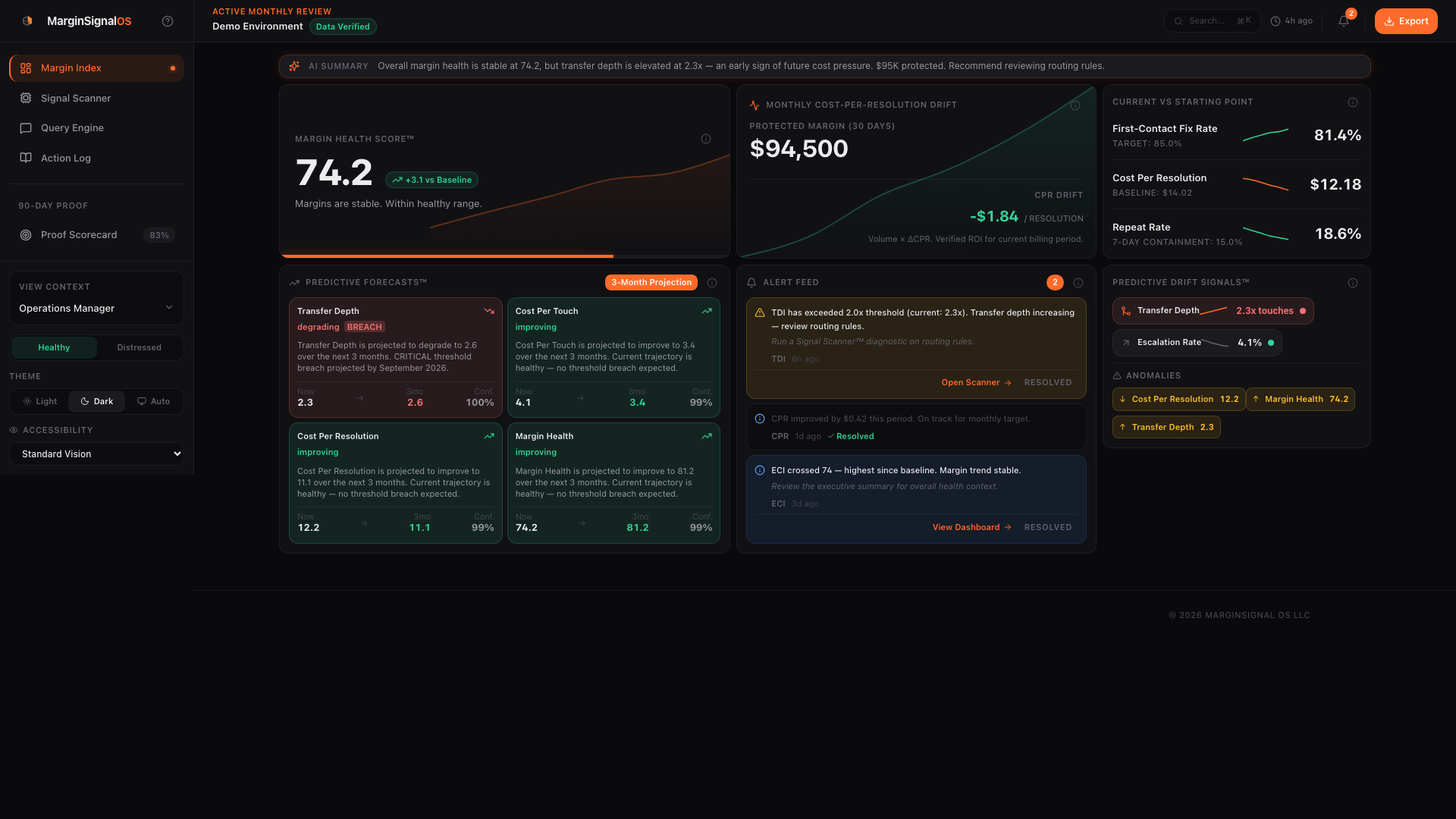
MarginSignal OS turns operational telemetry into an executive view of margin health, drift signals, proof windows, and fix accountability.
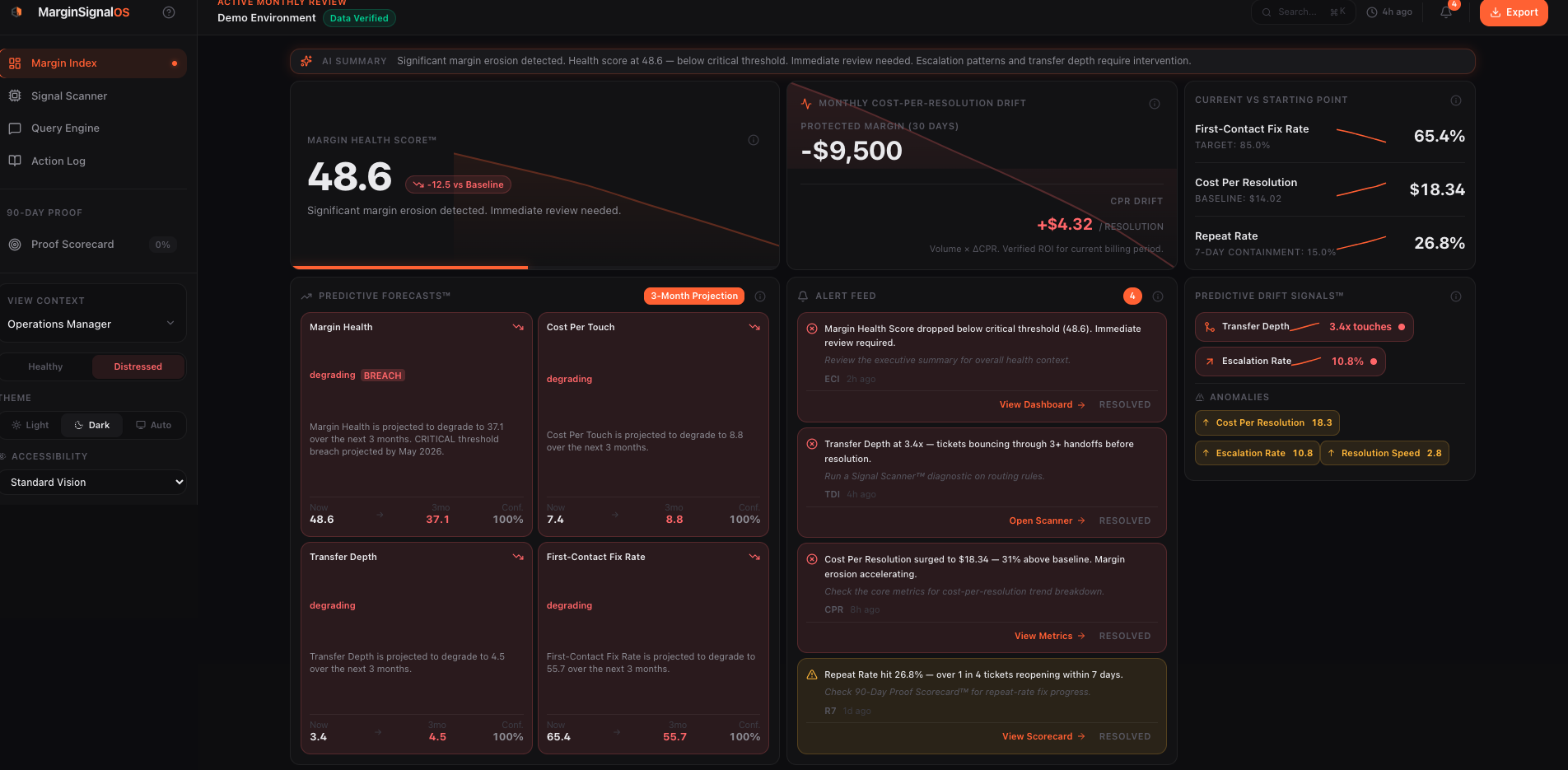
Same operation. Same baseline. The difference is whether structural leakage gets diagnosed and contained — or compounds for 90 days.
Illustrative sample environment.
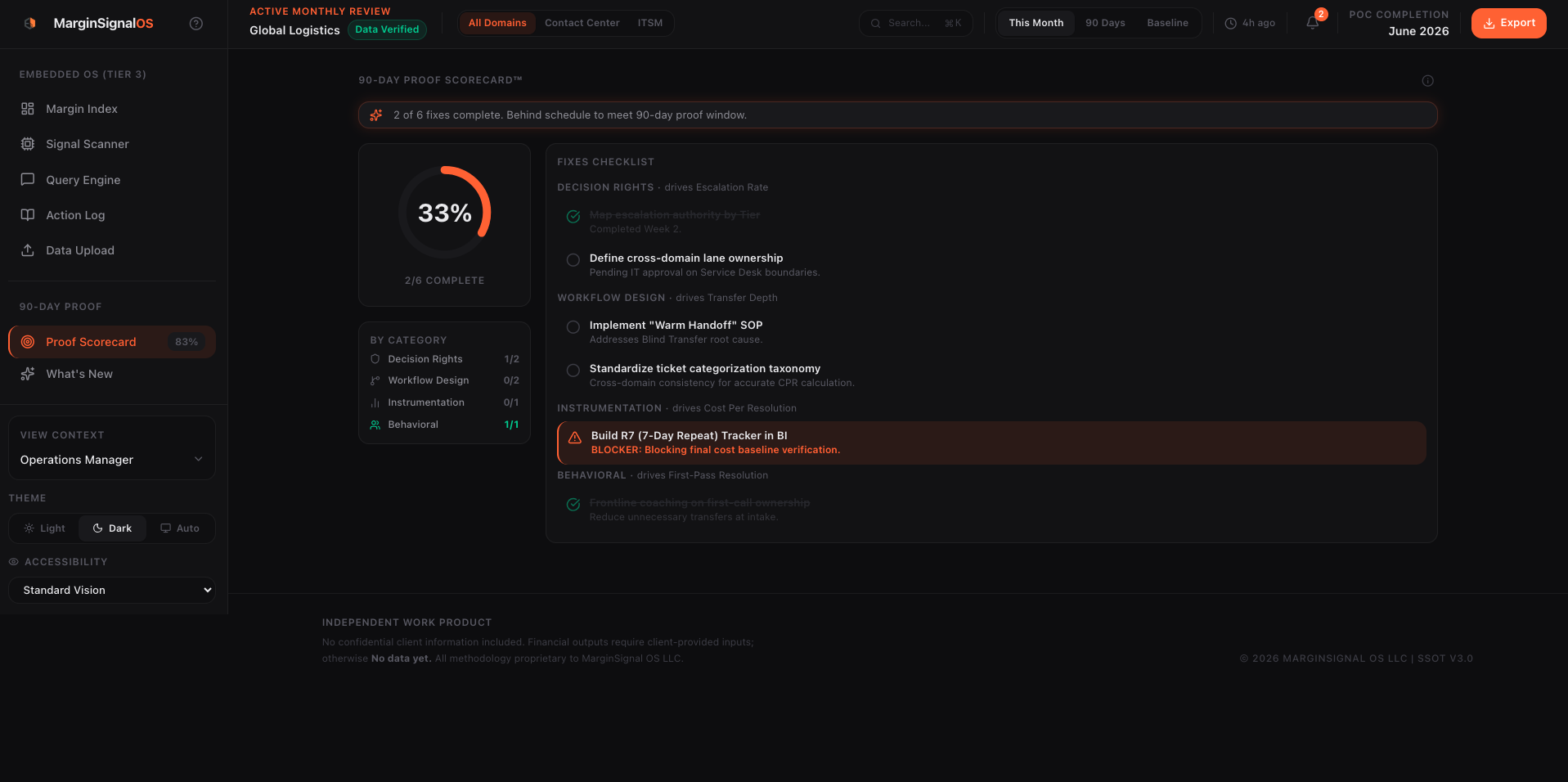
Illustrative sample environment. 90-day proof scorecard.
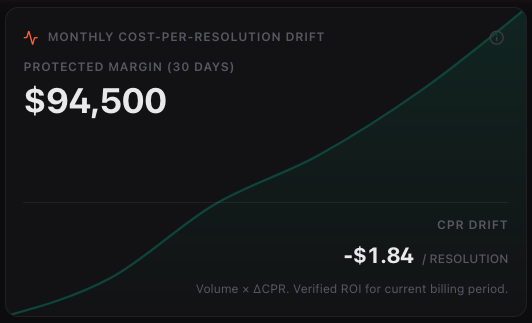
Illustrative sample environment. CPR drift view.
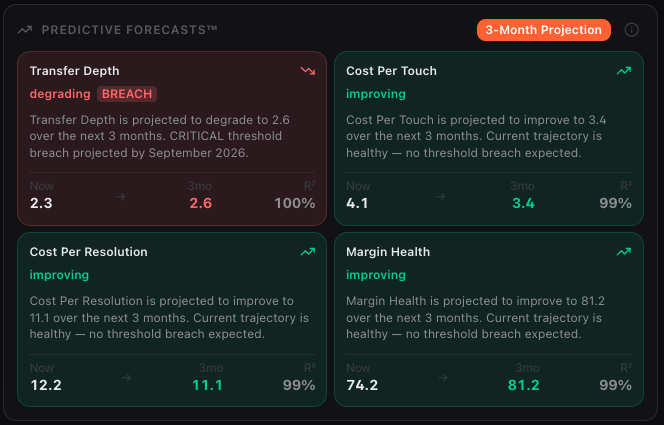
Illustrative sample environment. Predictive forecasts.
Try the Preliminary Scanner yourself, review the full sample output, or book a guided live demo of the MSOS Terminal. The live Terminal itself is invite-only with authenticated tenant access.

Your dashboards prove activity, not outcomes. The cost bleeds inside repeat contacts, transfer chains, escalation loops, and AI handoffs that close the ticket without solving the problem — and it rarely surfaces in standard reporting. Automation doesn't fix the leak. It runs it faster.
These friction patterns compound silently — a 3% repeat rate is not 3% waste. It is 3% compounding across every resolution chain, every day, in every domain you operate.
↳ 22% of interactions required a callback within 7 days.
↳ The callbacks averaged 12 minutes.
↳ 3 of them escalated (Authority Misalignment).
↳ 1 dispatched a truck.
We map 16 structural fault lines — including AI handoff degradation — to our CPR (Cost Per Resolution) economics model. Built from your operating data, not generic industry averages, and reproducible by someone who doesn't work for you.
| The Pivot Point | Structural Fault Line | Predictive Driver | Financial Impact |
|---|---|---|---|
| Transfer Count > 2 | Ownership Diffusion Across Handoffs | Transfer Depth | AWAITING... |
| Escalation Returned | Escalation Bounce (Authority Misalignment) | Escalation Bounce Rate | AWAITING... |
| Revisit within 14 Days | Field Revisit Normalization | 7-Day Repeat Rate | AWAITING... |
We map your telemetry against 16 structural fault lines, including AI handoff degradation where supporting data exists. No 8-week baselining period required.
Every repeat contact, transfer chain, and escalation loop has a dollar value. We calculate the true Cost Per Resolution — not per call, per resolution — so you see what it actually costs to make a customer issue go away.
Every Fault Line is assigned a "Moves-First Metric." We deploy behavioral coaching kits and 30-day containment plans giving leaders exact architectural corrections.
We're selecting a small number of design partners to produce the first public, reproducible CPR verdicts — on defined terms, at no or reduced fee. Going first should be easier than not.
No client logos to show you yet. That's the point: no other operator to protect, no result we've had reason to soften.
See the terms & applyDescribe a friction pattern wherever AI is handling resolutions. The Scanner maps it to one of 16 structural fault lines and surfaces a preliminary exposure range. Book a Findings Call to confirm against your data.
Prefer numbers? Try the 30-second CPR Gap Calculator →Use generalized examples only. Do not enter client names, PHI, PII, ticket IDs, or confidential operational data.
Awaiting Telemetry
Not software-only. Not consulting-only. An independent measurement system — from first assessment to continuous, verifiable proof.
Start with an Exposure Review. We confirm fit, data readiness, and the most likely fault-line hypothesis before recommending a diagnostic scope.
A scoped verification or a full diagnostic. We ingest your data, reconstruct resolution chains, and deliver ranked fault lines with dollar impact.
Dashboard access, drift monitoring, alerting, audit trail, and ongoing executive review. Continuous visibility into margin health — not a one-time PDF.
We auto-detect ticket structure from the platforms your operation already runs on. No API integration required.
Don't see yours? Custom CSV intake supported.
Founder
I spent 15 years measuring whether service operations actually worked — and watched “resolved” tickets quietly reopen while the dashboards stayed green. MarginSignal OS answers the only question that matters now that AI is doing the resolving: did it actually work, and at what true cost?
The why is personal. My father is a disabled veteran I care for, and navigating his claims taught me what happens when no one independent is checking whether the system delivered. I'm one person, on purpose — no operator to protect, no result I've had reason to soften. That's what an independent verifier is supposed to be.
Every engagement is led directly by the founder and scoped for hands-on execution.
The gap between Cost Per Call and Cost Per Resolution is structural. It compounds daily. And it is invisible to every dashboard in your building. We find it.